Pages

Tuesday, August 30, 2011

Review of "Anatomy of a Disappearance"


Anatomy of a Disappearance by Hisham Matar
Hamish Hamilton Canada


“There are times when my father’s absence is as heavy as a child sitting on my chest.”

With this tender opening sentence, Hisham Matar begins to weave a subtle pattern of absence and loss that defines the emotional territory of Anatomy of a Disappearance, his second novel.

The narrator of this beautifully paced story is Nuri el-Alfi, who at 14 loses his father when he disappears from an apartment in Geneva, likely the victim of a political kidnapping. The loss is unbearable yet even before his father’s disappearance; we discover that Nuri is no stranger to the subtractions of life.

At birth, Nuri had already lost his native country because his father, a close advisor to the deposed king, had been forced to flee to Egypt when a military regime took power. Safe in Cairo, the small el-Alfi family lives in a quiet luxury that belies the friction Nuri, an only child, senses between his parents. Nuri’s mother is habitually withdrawn, wrapped in a self-imposed silence, and his father travels often on business. The only constant in the boy’s lonely life is Naima, a young servant girl who is devoted to him in a way neither parent can seem to manage.

When he is ten, Nuri’s mother dies suddenly of an unnamed malady that the narrator, in retrospect, believes was the result of deep sorrow. “So old and persistent did Mother’s unhappiness seem that I never stopped to ask its true cause. Nothing is so acceptable as that which we are born into.”

Although in the end, Nuri will have three mothers, this is a story about the complicated relationship between fathers and sons. Like an insatiable thirst, Nuri craves an intimacy with his father that their love for each other fails to summon. He yearns “...for an easy sympathy... a kind of emotional eloquence and ease.”

Instead, his father unwittingly becomes Nuri’s rival when they both fall under the spell of the sensuous Mona whom they meet poolside at a resort in Alexandria. Mona is half-English, provocative and quickly, inspires a new nexus of desire in Nuri. The triangle – father, son and Mona - grows more brittle and difficult when Mona becomes Nuri’s stepmother despite his insistence that “I saw her first.”

Soon after the marriage, Nuri is sent off to a boarding school in England where he concocts schemes to steal time with Mona. As is often the case, you must be careful what you wish for. After his father’s disappearance, the relationship with Mona unravels as his father’s secret life is slowly revealed and Nuri learns what most children rarely acknowledge, that we really know little about the lives of our parents.

This is semi-autobiographical ground for Matar who was born in New York City to Libyan parents and raised in Tripoli and Cairo. His father, Jaballah Matar, was an influential businessman and a Qaddafi opponent, who was disappeared from Cairo in 1990 and interred in Libya. It is not known whether he is still alive as no one has seen him since 2002.
Now a resident of London, Matar’s first novel, In the Country of Men, was shortlisted for the Booker prize in 2006. It also was narrated by a young boy growing up in Libya with an unhappy mother and an absent father. Yet knowing how closely his fiction runs to Matar’s life in no way undermines the power of his writing - the aching simplicity by which he builds mood and pitch.

“Relatives and neighbours who might have filled the chairs in the hall if Father had died were silent in the face of his disappearance...A great emptiness began to fill the place of my father. It became unbearable to hear his name...At times it was almost possible to imagine he never existed. Yet every morning, when I opened my eyes, I believed he was there, that I would find him sitting at the dining room table, holding a cup of coffee in the air as he looked down at the folded newspaper in his lap.”

In passage like these, Matar limns the borders of loss with a fine, delicate hand and reminds us that not knowing can be the heaviest burden to bear.


Sunday, July 17, 2011

Country Roads

This morning, sitting on the deck, I watch a chipping sparrow, a tiny thing with a red cap, drift down from the clothesline onto the lawn. The movement is as effortless as a leaf floating off a tree. The bird disappears into the grass that goes to meadow mere days after being mowed.

In truth, it’s hardly grass at all but a pasture rich with tiny wild strawberries growing close to the ground among sweet pea, wild carrots, Queen Anne’s lace, daisies and black-eyed Susan. If I had my druthers, I wouldn’t mow it all but let it grow into what Axel calls a biotope.

Like many people, we live in the country for the nature and yet, most people cannot control their desire to shape the land, bend it to their will. There is this desire to create a fiefdom that would was unaffordable in the city. These 'castles'are surrounded by immaculate front lawns and constrained flower beds heaped with red cedar chips to prevent weeds.

Ralph Waldo Emerson said that a weed is a plant whose virtue has not yet been discovered. But this virtue is rarely recognized by those tending country lawns.

Birch, aspen, maple and pine are some of the many trees I can name in the deep wood that edges our backyard. I peer in amongst the trees to see if there is an opening. I don’t hear the digger today but that doesn’t stop me from worrying again about the road.

When Axel asked me if I could live anywhere in the world where would that be, I answered, “Right here” meaning Montreal. Then he asked if we could live in the suburbs and I looked at him oddly. Then I realized that in Europe, the suburbs are the small, often ancient towns that circle a large city. In short, Axel wanted to live in the country and that matched my own long-held desire. Give me trees and I’m the happiest of campers.

We bought the house in St-Colomban partly for its open airiness – a cathedral ceiling and windows everywhere – as well as for the tiara of trees that circle the property. Sitting at the dining room table, we can barely see our neighbour through the thicket that separates us. And the view out back through the glass sliding doors and onto the deck, is of forest and marsh where toad lilies and trillium grow in early spring. A hare lives there (or nearby) and four kinds of squirrels – pine, grey, black and a huge mottled fellow. Of course, there are raccoons and a dazzling array of birds from pileated woodpeckers to nuthatches. They visit my feeder every winter.

On the other side of the wood, our closest neighbour, is a farm with a few dairy cattle. It must be large because we only occasionally hear any lowing but just last week, driving along the road perpendicular to ours, I was thrilled to see two cows munching grass by the fence.

Now the wood is in danger. They’re building a road between us and the farm. That can mean only one thing, they’ll be cutting down trees to build houses to generate more tax revenue to build more roads and make the little town of St-Colomban which already has 90,000 people spread over a wide tract of land, become engorged with more box stores, more roads and less trees.

Since we’ve moved here, I have seen houses pop up like mushrooms in areas that had been forested. And with them, more little dead bodies on the side of the road.

And I wonder, where are all the animals supposed to go? And where will those country roads lead us next?

Wednesday, December 8, 2010

Remembering John

All day long people have been marking the death of John Lennon 30 years ago today. They played his songs on the radio, ran stories in the newspapers and on the nightly news; they posted nostalgia on Facebook.

All this nostalgia made me pine for a feeling I cannot duplicate no matter how hard I squeeze the emotion box. All day, what I wanted was to recapture a modicum of the excitement l felt about the Beatles when I was 15.

It was 1963, Dean Hagopian of CFOX (or was it Dave Boxer at CFCF) played Twist and Shout. The music was crazy-making. That tune was played about every 15 minutes and was soon alternating with Please Please Me and Love, Love Me Do. Just like that, I was hooked. There was something about the beat, the voices, the abandon - I couldn’t wait to hear the songs played over and over again. I stayed glued to the radio but when my friends all started to buzz about them I kept my excitement to myself. The Beatles were my guilty secret.

At 15, I was no dedicated follower of fashion. Elvis had always embarrassed me a little with that curl in his lip and what looked like too much mascara (nobody has lashes that black). I favoured neither Fabian (too pretty) nor Tab Hunter (even prettier), not crooning Frankie Avalon nor miniscule Paul Anka. In my book, none of the teen heartthrobs of the day could hold a candle to Cary Grant in Indiscreet or Humphrey Bogart in Casablanca. (I know, I was clearly living in the wrong decade.)

Then the Beatles arrived and changed all that. My new heartthrobs were no more than a few years older than me, in short, idols most eligible for serious fantasy.

My Beatle of choice was John. Maybe it was those sloping eyes or the pouty mouth with its sneaky smile. More likely, it was his brash irreverence, his clever quips that made no sense whatsoever (paving the way for my future love affair with Monty Python). I bought his book, In His Own Write, (it disappeared sometime in the 70s and is now on eBay selling for $6.98). Anyway, I practically memorized it.

About the Awful
I was bored on the 9th of Octover 1940 when, I believe, the Nasties were still booming us led by Madalf Heatlump (Who had only one). Anyway, they didn't get me. I attended to varicous schools in Liddypol. And still didn't pass-much to my Aunties supplies. As a member of the most publified Beatles me and (P, G, and R's) records might seem funnier to some of you than this book, but as far as I'm conceived this correction of short writty is the most wonderfoul larf I've ever ready.
God help and breed you all.

How could you not love such wit? I was besotted. And John was a poet, just like I was going to be one day (except he had a dark side).

Good Dog Nigel
Arf, Arf, he goes, a merry sight
Our little hairy friend
Arf, Arf, upon the lampost bright
Arfing round the bend.
Nice dog! Goo boy,
Waggie tail and beg,
Clever Nigel, jump for joy
Because we are putting you to sleep at three of the clock, Nigel.

The Beatles came to Montreal on September 8, 1964 but after cringing at the sight of screaming girls in the audience of The Ed Sullivan Show, I was too terrified to buy a ticket, imagining myself caught up in the hysteria. They only played for half an hour so I’m not sure I missed much. Oddly enough, Montreal was the only city on that first and very long North American tour that did not sell out.

As compensation, I bought their second album With the Beatles even though I didn’t own a stereo. But that cover! I pored over those faces photographed in half shadow and mooned over John obsessively. That album was release on the day President Kennedy was shot.

The departure of Kennedy and the arrival of the Beatles are intertwined in my memory. It seems we lost Camelot but were rescued by four lads who led us into a new age - and still have a power to transport us after all these years.

Sunday, October 24, 2010

The Making of a Documentary - PART I

It’s 1993.
I read a review on an Oscar-nominated foreign film called “The Nasty Girl,” based on a true story about a head-strong young woman from Passau, Germany.

Passau?
But I was born in Passau!
We left when I was 14 months. We were refugees (not German) and needed a less hostile country to start a new life yet growing up in Montreal I manage only twice to find a map reference to this Bavarian town on the Danube.

All I knew of Passau.
Every year on my birthday, my mother told me how she saved my life because, not trusting the doctors in the DP camp, she made certain I was born in the hospital in nearby Passau.

It was just another story.
My mother had too many. This one I interpreted as yet one more ploy to convince me that I should be grateful to her for giving me life. Considering our never-ending conflict, I was not inclined to take this seriously.

Das schreckliche Mädchen
So, in 1993, I see The Nasty Girl, a story about a young woman whose community turns against her when she investigates the town's Nazi past. Afterwards, I think that one day I should contact the real-life nasty girl, Anna Rosmus.

Eleven years later.
At Montreal’s Blue Met Literary Festival, I’m chatting with Verena Stefan, a Swiss-German writer, and mention that I’m planning a trip to Passau to do research for a novel.

She says, Ah! You should get in touch with Anna Rosmus.

I say, I would love to…and before I can finish the sentence, Verena taps a woman on the shoulder and says, Karin, this is Gina. She would like to be in touch with Anna Rosmus. Would you send her the email address?

Is that all it takes?
Ask and you receive. I contact Anna and begin my letter like this:
“I am a writer and poet living in Montreal, and although my parents were refugees living in Pocking-Waldstadt, like you, I was born in Passau. My mother said she didn’t trust the doctors in the DP camp.”

Anna writes back:
“Oh, she must have heard about all the baby deaths in ’46 and ’47. There were 57 babies murdered.”

I was born January, 1948.
Wait. That means my mother was not a paranoid Holocaust survivor. And she did save my life. That’s where this story begins. The story called “My Mother, the Nazi Midwife and Me.”

www.nazimidwife.com

Sunday, October 17, 2010

Book Review: The Particular Sadness of Lemon Cake

The Particular Sadness of Lemon Cake, by Aimee Bender, Doubleday


In her second novel, The Particular Sadness of Lemon Cake, Aimee Bender takes some simple ingredients –an appealing protagonist and a talent for storytelling - to concoct a delicate, richly nuanced narrative about an ordinary family with some extraordinary abilities.

On her ninth birthday, Rose Edelstein receives a gift she does not want and cannot return when she discovers she can taste the emotions of whoever has prepared her food. This is revealed after Rose takes a bite of the particular cake of the title, a birthday cake baked by the cheerful, engaging mother she adores. What she tastes, however, translates as “absence, hunger, spiraling, hollows.” Unable to communicate what she feels to her mother, Rose swallows what she has learned.

Silence is an unacknowledged member of the Edelstein family of Hollywood, CA, a town where appearance and reality are rarely acquainted. Outwardly, the Edelsteins give the impression that they’re perfectly normal. Dad is a lawyer and Mom, a housewife adroit at everything yet always seeking new challenges. Young Rose, unremarkable but appealing, adores her older brother, Joseph, who is thought to be something of a genius. He has a laconic nature that comes off as teenage angst. Rose and her parents, on the other hand, do converse during shared meals, yet nothing telling is ever revealed in their conversations.

The sadness in the lemon cake is the first of many experiences that will shape and rule Rose’s life but it takes her time to define what happens to her when she eats. Yet knowing is not the same as understanding or accepting, such as the time Rose, a loving daughter, tries to share what she has learned from her mother’s pie.
“You’re so sad in there...and alone, and hungry, and sad–”
“In where??”
“In the pie.”

Rose is devastated not only by what she learns but also by her mother’s staunch refusal to acknowledge the truth. This makes Rose’s gift twice as unpalatable. Along with the emotions of others, she learns she must swallow their secrets.

How many times have we wished we could truly understand what is going on with a parent or a sibling? Bender shows us the perils of too much information. With each bite of this beautifully-written novel, she reminds us how little we know about the family we are born into, and how much love and acceptance is needed when truths are revealed.

Ultimately, the Edelsteins are a family of loners, emotionally invisible to each other. Even the last living grandparent is so detached as to replace affection with shipments of used furniture.

Rose’s dad works hard to hold his world in check. His motto says it all: “Keep it simple.” He is contained and rational, except when it comes to hospitals, which he will go blocks out of his way to avoid. Oddly, no one ever challenges this bizarre behaviour that leaves him at the hospital door when his wife is giving birth or his son is deathly ill.

Rose’s mother is disillusioned with her marriage, dissatisfied with her lack of accomplishment and unable to fathom why the son she loves so deeply is unreachable. She is dogged in her effort to keep him connected to her and the family, despite his manifest desire to be left alone. In the end, however, neither she nor Rose can prevent Joseph’s disappearance.

What holds this sometimes illusory story and the Edelstein family together is Rose. From the pitch-perfect nine year-old to the woman she finally becomes, Bender’s ability to transfer Rose’s every emotion to her reader is an accomplishment worthy of a remarkable storyteller and a world class confectioner.


This review originally appeared in Rover Arts
http://roverarts.com/2010/10/having-sadness-and-eating-it-too/

Monday, August 23, 2010

MOOSE! Moose. moose?


At Gros Morne, the Parks Canada guide confirmed what we had read in the brochures: there are four moose for every two persons of every square kilometer of Newfoundland Labrador. This is a province the size of Texas but with only half a million residents, not counting the moose.
We had been on The Rock three days and had seen a fair number of locals but despite keeping a sharp lookout, nary a moose came into view.
As we drove along the Trans-Canada Highway, I scanned every marsh, pond, lake and river from Port-aux-Basque and all along the western shore up to Gros Morne National Park.
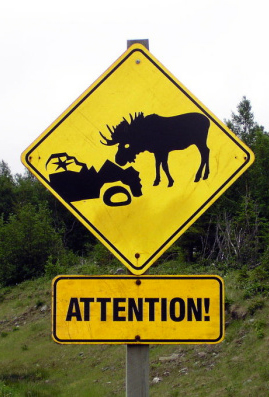
For me, finding a moose was a matter of national pride; the Canadian brand was at stake. I had promised Axel, a skeptical European, that there will be many moose sightings on our east coast trip. I had expected we would see some along the Cabot Trail as we drove to North Sydney for the ferry. Although the vistas were as breathtaking as ever, they did not include the hulking shape of a big-racked, heavy headed bull moose so prominently displayed on the signs along the highway.
“There are really no moose in Canada,” Axel said, laying out the bait after three expectation-filled days.
“Of course there are,” I replied. “Patience. It takes patience.”
And patience did pay off. Sort of.
On our third day in Gros Morne, coming back from a beautiful 11 kilometer hike to Bakers Brook Falls, right near the parking lot, we spotted a moose pie the size of a pumpernickel. As we stepped off the trail onto the lot, the back end of a moose disappeared into the brush.
“There,” I said. “We’ve seen our first moose.”
Axel, being German, corrected my imprecise statement.
“What we’ve seen is ¾ of a moose, no head. And I’m not sure that it wasn’t planted there by Parks Canada. Maybe they have a few moose they move around to trick people into believing they’re everywhere.”
“Like moose on wheels,” I said in an attempt to belittle the notion.
“Exactly,” he said. Apparently, I had only succeeded in adding fuel to the fire.
“They probably only have so many moose in stock and so they have to move them around quickly. Wheels are most efficient. We saw moose number 57,” Axel said with a conviction I would later find irresistible.
As we drove through the countryside that was always conducive to sightings, Axel would take up a plaintive chant: “Moose, moose, moooose,” he’d call.
As we moved around the province, whomever we met, we would herald the beauty of the landscape but complain about the lack of moose. As a response, we were warned over and again that seeing a moose on the highway was usually not a good thing, nothing to be desired. There are no official figures available but everyone has a story about the perils of hitting a moose.
Everyone also had a ‘nuisance moose’ story, to assure us how plentiful the moose are. Bernadette’s sister, Betty, has a moose sleeping on her back doorstep like a big old dog; John Fisher of Fishers’ Loft told us about a bar-b-q crashing moose. Robert Hall of Ryan Mansion complained that there were seven moose that made themselves to home in his back yard and refused to be shooed away.
All these stories were well-intended, meant to provide proof about the presence of moose in Newfoundland Labrador.
But seeing is believing.
And we looked and looked.
We covered 4,300 kilometers from Halifax to St. John’s and back again. We wanted to believe all the stories but in the end, all we ever saw was the end of moose #57 in service to Parks Canada.
But you’ll have a chance to prove us wrong, Newfoundland Labrador, ‘cause we’ll be back.