Tuesday, January 4, 2011


Wednesday, December 8, 2010
Remembering John
All day long people have been marking the death of John Lennon 30 years ago today. They played his songs on the radio, ran stories in the newspapers and on the nightly news; they posted nostalgia on Facebook.
All this nostalgia made me pine for a feeling I cannot duplicate no matter how hard I squeeze the emotion box. All day, what I wanted was to recapture a modicum of the excitement l felt about the Beatles when I was 15.
It was 1963, Dean Hagopian of CFOX (or was it Dave Boxer at CFCF) played Twist and Shout. The music was crazy-making. That tune was played about every 15 minutes and was soon alternating with Please Please Me and Love, Love Me Do. Just like that, I was hooked. There was something about the beat, the voices, the abandon - I couldn’t wait to hear the songs played over and over again. I stayed glued to the radio but when my friends all started to buzz about them I kept my excitement to myself. The Beatles were my guilty secret.
At 15, I was no dedicated follower of fashion. Elvis had always embarrassed me a little with that curl in his lip and what looked like too much mascara (nobody has lashes that black). I favoured neither Fabian (too pretty) nor Tab Hunter (even prettier), not crooning Frankie Avalon nor miniscule Paul Anka. In my book, none of the teen heartthrobs of the day could hold a candle to Cary Grant in Indiscreet or Humphrey Bogart in Casablanca. (I know, I was clearly living in the wrong decade.)
Then the Beatles arrived and changed all that. My new heartthrobs were no more than a few years older than me, in short, idols most eligible for serious fantasy.
My Beatle of choice was John. Maybe it was those sloping eyes or the pouty mouth with its sneaky smile. More likely, it was his brash irreverence, his clever quips that made no sense whatsoever (paving the way for my future love affair with Monty Python). I bought his book, In His Own Write, (it disappeared sometime in the 70s and is now on eBay selling for $6.98). Anyway, I practically memorized it.
About the Awful
I was bored on the 9th of Octover 1940 when, I believe, the Nasties were still booming us led by Madalf Heatlump (Who had only one). Anyway, they didn't get me. I attended to varicous schools in Liddypol. And still didn't pass-much to my Aunties supplies. As a member of the most publified Beatles me and (P, G, and R's) records might seem funnier to some of you than this book, but as far as I'm conceived this correction of short writty is the most wonderfoul larf I've ever ready.
I was bored on the 9th of Octover 1940 when, I believe, the Nasties were still booming us led by Madalf Heatlump (Who had only one). Anyway, they didn't get me. I attended to varicous schools in Liddypol. And still didn't pass-much to my Aunties supplies. As a member of the most publified Beatles me and (P, G, and R's) records might seem funnier to some of you than this book, but as far as I'm conceived this correction of short writty is the most wonderfoul larf I've ever ready.
God help and breed you all.
How could you not love such wit? I was besotted. And John was a poet, just like I was going to be one day (except he had a dark side).Good Dog Nigel
Arf, Arf, he goes, a merry sight
Our little hairy friend
Arf, Arf, upon the lampost bright
Arfing round the bend.
Nice dog! Goo boy,
Waggie tail and beg,
Clever Nigel, jump for joy
Because we are putting you to sleep at three of the clock, Nigel.
The Beatles came to Montreal on September 8, 1964 but after cringing at the sight of screaming girls in the audience of The Ed Sullivan Show, I was too terrified to buy a ticket, imagining myself caught up in the hysteria. They only played for half an hour so I’m not sure I missed much. Oddly enough, Montreal was the only city on that first and very long North American tour that did not sell out.
As compensation, I bought their second album With the Beatles even though I didn’t own a stereo. But that cover! I pored over those faces photographed in half shadow and mooned over John obsessively. That album was release on the day President Kennedy was shot.
The departure of Kennedy and the arrival of the Beatles are intertwined in my memory. It seems we lost Camelot but were rescued by four lads who led us into a new age - and still have a power to transport us after all these years.
Sunday, October 24, 2010
The Making of a Documentary - PART I
It’s 1993.
I read a review on an Oscar-nominated foreign film called “The Nasty Girl,” based on a true story about a head-strong young woman from Passau, Germany.
Passau?
But I was born in Passau!
We left when I was 14 months. We were refugees (not German) and needed a less hostile country to start a new life yet growing up in Montreal I manage only twice to find a map reference to this Bavarian town on the Danube.
All I knew of Passau.
Every year on my birthday, my mother told me how she saved my life because, not trusting the doctors in the DP camp, she made certain I was born in the hospital in nearby Passau.
It was just another story.
My mother had too many. This one I interpreted as yet one more ploy to convince me that I should be grateful to her for giving me life. Considering our never-ending conflict, I was not inclined to take this seriously.
Das schreckliche Mädchen
So, in 1993, I see The Nasty Girl, a story about a young woman whose community turns against her when she investigates the town's Nazi past. Afterwards, I think that one day I should contact the real-life nasty girl, Anna Rosmus.
Eleven years later.
At Montreal’s Blue Met Literary Festival, I’m chatting with Verena Stefan, a Swiss-German writer, and mention that I’m planning a trip to Passau to do research for a novel.
She says, Ah! You should get in touch with Anna Rosmus.
I say, I would love to…and before I can finish the sentence, Verena taps a woman on the shoulder and says, Karin, this is Gina. She would like to be in touch with Anna Rosmus. Would you send her the email address?
Is that all it takes?
Ask and you receive. I contact Anna and begin my letter like this:
“I am a writer and poet living in Montreal, and although my parents were refugees living in Pocking-Waldstadt, like you, I was born in Passau. My mother said she didn’t trust the doctors in the DP camp.”
Anna writes back:
“Oh, she must have heard about all the baby deaths in ’46 and ’47. There were 57 babies murdered.”
I was born January, 1948.
Wait. That means my mother was not a paranoid Holocaust survivor. And she did save my life. That’s where this story begins. The story called “My Mother, the Nazi Midwife and Me.”
www.nazimidwife.com
Sunday, October 17, 2010
Book Review: The Particular Sadness of Lemon Cake
The Particular Sadness of Lemon Cake, by Aimee Bender, Doubleday
In her second novel, The Particular Sadness of Lemon Cake, Aimee Bender takes some simple ingredients –an appealing protagonist and a talent for storytelling - to concoct a delicate, richly nuanced narrative about an ordinary family with some extraordinary abilities.
On her ninth birthday, Rose Edelstein receives a gift she does not want and cannot return when she discovers she can taste the emotions of whoever has prepared her food. This is revealed after Rose takes a bite of the particular cake of the title, a birthday cake baked by the cheerful, engaging mother she adores. What she tastes, however, translates as “absence, hunger, spiraling, hollows.” Unable to communicate what she feels to her mother, Rose swallows what she has learned.
Silence is an unacknowledged member of the Edelstein family of Hollywood, CA, a town where appearance and reality are rarely acquainted. Outwardly, the Edelsteins give the impression that they’re perfectly normal. Dad is a lawyer and Mom, a housewife adroit at everything yet always seeking new challenges. Young Rose, unremarkable but appealing, adores her older brother, Joseph, who is thought to be something of a genius. He has a laconic nature that comes off as teenage angst. Rose and her parents, on the other hand, do converse during shared meals, yet nothing telling is ever revealed in their conversations.
The sadness in the lemon cake is the first of many experiences that will shape and rule Rose’s life but it takes her time to define what happens to her when she eats. Yet knowing is not the same as understanding or accepting, such as the time Rose, a loving daughter, tries to share what she has learned from her mother’s pie.
“You’re so sad in there...and alone, and hungry, and sad–”
“In where??”
“In the pie.”
Rose is devastated not only by what she learns but also by her mother’s staunch refusal to acknowledge the truth. This makes Rose’s gift twice as unpalatable. Along with the emotions of others, she learns she must swallow their secrets.
How many times have we wished we could truly understand what is going on with a parent or a sibling? Bender shows us the perils of too much information. With each bite of this beautifully-written novel, she reminds us how little we know about the family we are born into, and how much love and acceptance is needed when truths are revealed.
Ultimately, the Edelsteins are a family of loners, emotionally invisible to each other. Even the last living grandparent is so detached as to replace affection with shipments of used furniture.
Rose’s dad works hard to hold his world in check. His motto says it all: “Keep it simple.” He is contained and rational, except when it comes to hospitals, which he will go blocks out of his way to avoid. Oddly, no one ever challenges this bizarre behaviour that leaves him at the hospital door when his wife is giving birth or his son is deathly ill.
Rose’s mother is disillusioned with her marriage, dissatisfied with her lack of accomplishment and unable to fathom why the son she loves so deeply is unreachable. She is dogged in her effort to keep him connected to her and the family, despite his manifest desire to be left alone. In the end, however, neither she nor Rose can prevent Joseph’s disappearance.
What holds this sometimes illusory story and the Edelstein family together is Rose. From the pitch-perfect nine year-old to the woman she finally becomes, Bender’s ability to transfer Rose’s every emotion to her reader is an accomplishment worthy of a remarkable storyteller and a world class confectioner.
This review originally appeared in Rover Arts
http://roverarts.com/2010/10/having-sadness-and-eating-it-too/
Monday, August 23, 2010
MOOSE! Moose. moose?
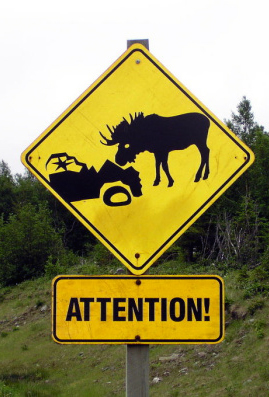
At Gros Morne, the Parks Canada guide confirmed what we had read in the brochures: there are four moose for every two persons of every square kilometer of Newfoundland Labrador. This is a province the size of Texas but with only half a million residents, not counting the moose.
We had been on The Rock three days and had seen a fair number of locals but despite keeping a sharp lookout, nary a moose came into view.
As we drove along the Trans-Canada Highway, I scanned every marsh, pond, lake and river from Port-aux-Basque and all along the western shore up to Gros Morne National Park.
For me, finding a moose was a matter of national pride; the Canadian brand was at stake. I had promised Axel, a skeptical European, that there will be many moose sightings on our east coast trip. I had expected we would see some along the Cabot Trail as we drove to North Sydney for the ferry. Although the vistas were as breathtaking as ever, they did not include the hulking shape of a big-racked, heavy headed bull moose so prominently displayed on the signs along the highway.
“There are really no moose in Canada,” Axel said, laying out the bait after three expectation-filled days.
“Of course there are,” I replied. “Patience. It takes patience.”
And patience did pay off. Sort of.
On our third day in Gros Morne, coming back from a beautiful 11 kilometer hike to Bakers Brook Falls, right near the parking lot, we spotted a moose pie the size of a pumpernickel. As we stepped off the trail onto the lot, the back end of a moose disappeared into the brush.
“There,” I said. “We’ve seen our first moose.”
Axel, being German, corrected my imprecise statement.
“What we’ve seen is ¾ of a moose, no head. And I’m not sure that it wasn’t planted there by Parks Canada. Maybe they have a few moose they move around to trick people into believing they’re everywhere.”
“Like moose on wheels,” I said in an attempt to belittle the notion.
“Exactly,” he said. Apparently, I had only succeeded in adding fuel to the fire.
“They probably only have so many moose in stock and so they have to move them around quickly. Wheels are most efficient. We saw moose number 57,” Axel said with a conviction I would later find irresistible.
As we drove through the countryside that was always conducive to sightings, Axel would take up a plaintive chant: “Moose, moose, moooose,” he’d call.
As we moved around the province, whomever we met, we would herald the beauty of the landscape but complain about the lack of moose. As a response, we were warned over and again that seeing a moose on the highway was usually not a good thing, nothing to be desired. There are no official figures available but everyone has a story about the perils of hitting a moose.
Everyone also had a ‘nuisance moose’ story, to assure us how plentiful the moose are. Bernadette’s sister, Betty, has a moose sleeping on her back doorstep like a big old dog; John Fisher of Fishers’ Loft told us about a bar-b-q crashing moose. Robert Hall of Ryan Mansion complained that there were seven moose that made themselves to home in his back yard and refused to be shooed away.
All these stories were well-intended, meant to provide proof about the presence of moose in Newfoundland Labrador.
But seeing is believing.
And we looked and looked.
We covered 4,300 kilometers from Halifax to St. John’s and back again. We wanted to believe all the stories but in the end, all we ever saw was the end of moose #57 in service to Parks Canada.
But you’ll have a chance to prove us wrong, Newfoundland Labrador, ‘cause we’ll be back.
Monday, July 12, 2010
THE GODS ARE CRAZY (or What Goes Around Comes Around)
This morning we finished the jar of honey from Germany that Axel had packed into the bulging container that had arrived as big as a circus. As I was about to throw the jar away, my eye fell on one word on the German label: Kanada. This jar of German-bottled honey that had been filled courtesy of Canadian bees, had finally made its way home to Canada after sitting for years in Axel’s cupboard in Cologne.
I loved the movie “The Gods Must be Crazy,” the story of a Kalahari Bushman who while hunting is knocked unconscious by a Coke bottle thrown from a passing biplane. Never having seen anything like it, and falling from the sky, the Bushman surmises that the bottle is a gift from the gods. As such, it soon becomes a symbol of power and object of jealousy amongst the otherwise congenial tribe members. The Bushman, seeing the trouble the gift was brewing undertakes to return the dangerous it to the gods by traveling to the end of the world to give it back.
This movie and the jar of honey remind me that once I too returned a bottle to its ‘source.’
In 1993, I was in Puerta Vallarta at my first-ever Society of American Travel Writers’ convention. We were being hosted by a beautiful, new property in Nuevo Vallarta which had, much to our surprise, potable water flowing from their taps. Many of us had judiciously brought bottled water with plans to buy more as needed. One member out of Houston, Texas, had gone one step further. Obviously, a man with foresight as well as a thirst, the journalist had brought two cases of large bottles to the convention. But there was no need for the bottled water so by the end the week, he still had a cache of forty-two bottles.
There was no way he was taking them back home. So rather than waste the precious resource, he plunked himself down in the lobby on the day we were all checking out, and gave away bottles to all takers. Thinking ahead to how long and arduous my day was going to be with a flight schedule that would bounce me from Puerto Vallarta to Guadalajara to Mexico City to Chicago and finally, to Montreal, I thanked him for his generosity and quickly stuffed a bottle into my bag.
I sipped a little from that bottle all along the way and finally finished it off just as we were coming in for a landing in Montreal. At the time, it was Mirabel Airport that served international flights to and from Montreal. I was exhausted from a day of take-offs and landings, and had finished reading everything I had brought. Out of boredom, I turned the bottle around in my hand to read the label. It was a bottle of Naya Spring Water, a brand name that was just beginning to become familiar. And then I saw where it was bottled. Mirabel, Quebec.
The Naya water had travelled from Mirabel, Quebec to Houston, Texas to Puerto Vallarta, Jalisco and back to Mirabel. Before heading to customs, I dropped the bottle in an airport bin and waved a mental goodbye, content in having played my part in bringing it back to its source.
Thursday, July 1, 2010
Skinned
There are concessions to make when living with someone. Three years ago, my partner and I, along with our two cats, moved in together. The house is located in the lower Laurentians because we both have a love and need for nature to surround us. It’s a lovely house with an open plan and we filled it with things accumulated through a lifetime of acquisitions and travel.
It was a little frightening at first because we both have a lot of stuff. Luckily, our tastes are similar and our furniture and art blended together nicely. I only had one serious objection to overcome. Axel had spent the better part of the 70s living in Africa, first Nigeria and then in South Africa. During those years, he collected many beautiful artifacts but there are a few I could have done without. Along with items like a magnificent Yoruba mahogany mask and beaded bushman’s skirt, he also brought two animal skins - a zebra and a springbok. Knowing they died long ago has not made it any easier to see them stretched out on the basement floor.
From the time I was a child, I had a strong dislike of using animal skins as decoration. My father, a tailor, regularly worked to convince me to allow him to put “…a little fur on the collar” when sewing my winter coat. I could never say yes although I knew it hurt him. To his mind, no fur on the collar was an indication that he was not earning enough to properly outfit his only daughter. So living with these skins means I have to curb my natural aversion. My solution is to walk around them. Even the cats walk around them although I’m not sure it’s for the same reason.
Axel did not kill these animals. In fact, he goes to extraordinary measures to rescue any living thing, be it a fly or a mouse, in order to release it outside rather than harm it in any way. (Killing is reserved strictly for mosquitoes and black flies.) Being of like mind about respecting life has led us to considerable research on how to repel the field mice that find any number of ways of getting into the house. We favour things like steel wool and sonic repellants. But these are beasties determined to get in. When we managed to block the wall that provided access to the cupboard under the sink, they began showing up in the dishwasher. How they got in and out without getting drowned is still a head scratcher. Anyway, we thought we had won that battle. Then last week, Mumzer, our ever efficient black cat, caught a mouse running around the TV as I was watching it. I saw the tiny little thing cowering among the wires. Suddenly, Mumzer pounced but Axel also leapt into action and cornered the cat, firmly but delicately extracted the mouse from his mouth and while I congratulated Mumzer on his excellent reflexes, Axel release the terrified beastie outside.
We were feeling very self-satisfied with our humanitarian efforts until this morning when I lifted the mat on Axel’s side of the bed. It seems that Mumzer has undertaken a project to produce his own animal skin rugs. There, beneath the mat was a flattened mouse skin, little legs to the side, tail curled upwards, headless - a miniature animal skin being cured in my very own bedroom.
“How did it get so flat? Did you squash it inadvertently getting out of bed?” I asked Axel.
“Not likely,” he said, “Looks like Mumzer ate everything but the skin, tail and feet.”
I looked with sadness at the shell of the beastie, then, asked Axel to dispose of it. This is one animal skin I do not have to live with.
Subscribe to:
Posts (Atom)